
Tag: space
-
Astrophotography, a barred spiral galaxy
This latest Picture of the Month from the NASA/ESA/CSA James Webb Space Telescope features Messier 77 (M77), a barred spiral galaxy famous and appreciated among astronomers for its combination of relative proximity and spectacular features to study. It is located 45 million light-years away in the constellation Cetus (The Whale). This new image from Webb’s Mid-Infrared Instrument (MIRI) highlights its swirling spiral arms, the dust in its disc and its piercingly bright core like never before. At the heart of M77 is a compact region filled with hot gas that handily outshines the rest of the galaxy put together, even overcoming the light-gathering capacity of Webb’s cameras. This is an active galactic nucleus (AGN), and it’s powered by M77’s central supermassive black hole, which is eight million times as massive as our Sun. Gas in the galaxy’s central regions is pulled by the strong gravity into a tight and rapid orbit around the black hole, where it crashes together and heats up, releasing tremendous amounts of radiation. The bright orange lines appearing to radiate out from the centre of M77 are not actually a feature of the galaxy: they are a type of distortion that arises from the optical design of the telescope. Called diffraction spikes, they are created because the intense light from the unresolved AGN is bent (“diffracted”) very slightly at the edges of Webb’s hexagonal mirror panels and around one of the struts that hold up its secondary mirror. This distinctive six-plus-two-pointed pattern is the same for any image taken by Webb. For diffraction spikes to appear, the light source has to be very bright and very concentrated, so they’re most often seen on stars. But in some galaxies, as here, the nucleus is bright and compact enough to make diffraction spikes appear as well. M77 is not just known for its easily visible AGN, but also as a prolific star-forming galaxy. The near-infrared image of M77 reveals a bar spanning across the central r -
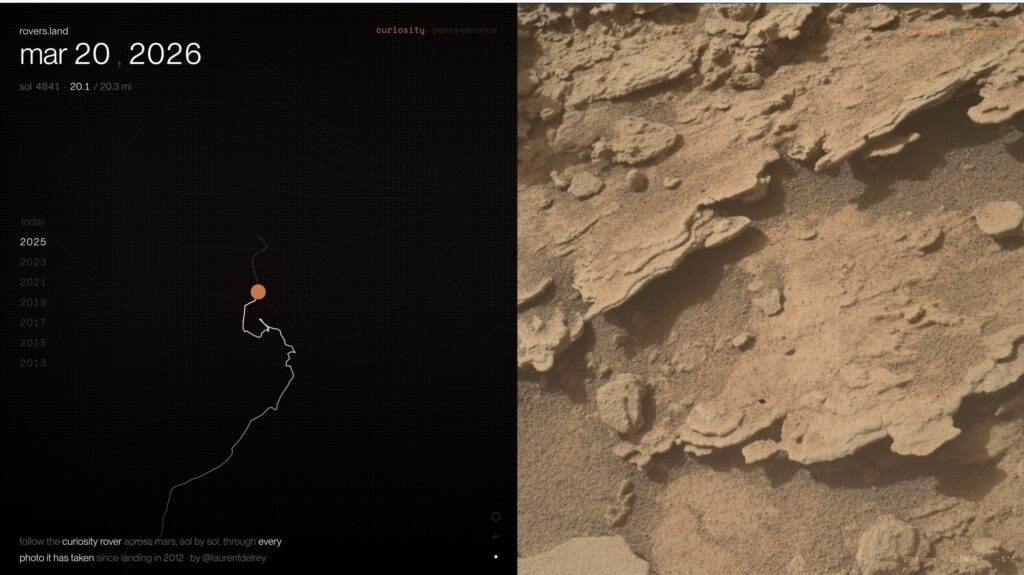
Follow the Mars Curiosity rover
Part map, timeline, and image archive, https://www.rovers.land puts a fun interface together to view the Mars Curiosity rover.
-
Artemis II launch stops a softball game
Artemis II launched a crew to orbit the moon on April Fools Day. It occurred during the same time as a women’s softball game between the University of Florida and Stetson. As the Artemis rocket ascended, the game stopped, and the entire stadium watched.
-
How to colonize space according to archeologists
Humanity traveled the world throughout its history, creating colonies and cities–for better or worse. If we are to travel through space to other planets, we might need to consider lessons from our past.
Their paper, which is published in Acta Astronautica, uses island archaeology to outline eight different lessons that can impact the success of ongoing space colonization efforts. Considerations for space colonization go beyond just the technical abilities to live on the surface of another world—they have to consider resource availability, genetics, and cultural ties as well.
The authors split the eight lessons into two main categories—physiological factors and biocultural factors. Their first lesson is that distance is important—no surprise there really. Colonization of other islands is most successful when they are close to their source population. This allows help to arrive faster if needed, but also allows the colony‘s population to be part of a “metapopulation” with the source population.