Category: Science
Do anything related to science biology, chemistry, physics, astronomy, etc
-
There’s a whale graveyard
Along a stretch of the Indian Ocean, there’s a whale graveyard.
Here we report the discovery of a vast whale necropolis in the Diamantina Zone (4,616- to 7,001-m depth), extending about 1,200 km along the sea floor of the southeastern Indian Ocean. This area has a deep and extensive accumulation comprising five modern natural whale-fall communities and 476 fossil cetaceans recorded. We show that carcasses host specialized communities dominated by brittle stars, bone-boring worms and chemosynthesis-based bivalves and that the fossil record in this area comprises both extant and extinct deep-diving beaked whales. Isotopic dating shows that whale falls in this region have occurred since at least 5.3 million years ago. These findings reshape the understanding of the limits and biogeography of whale-fall ecosystems and establish some deep sea floors as a fossil archive for tracing cetacean evolution over geological time.
-
Cocaine pollution affects fish
Drugs in wastewater isn’t new, but we now have evidence of its environmental affects.
Juvenile Atlantic salmon that were artificially exposed to the drug and its main breakdown product swam further and dispersed more widely across a lake, suggesting the substances can affect where the fish go, what they eat and how vulnerable they are to predators.
And
Scientists have said before that pollution from common drugs poses “a major and escalating risk to biodiversity” and have called on pharmaceutical companies to make greener medicines that breakdown in the environment. Concerns over the contaminants have been fuelled by reports of trout “addicted” to methamphetamine and perch losing their fear of predators because of antidepressant medications.
-
Geography is 4 dimensional
Derek Sivers makes the case that geography can also be mentioned by time.
When someone speaks of a place, you have to ask, “When?” Geography is four-dimensional. You can’t know a place – only a place as it was at a time. Where is bound to when. Unless you are in a place right now, you can only speak of it in past-tense.
-
Astrophotography, a barred spiral galaxy

This latest Picture of the Month from the NASA/ESA/CSA James Webb Space Telescope features Messier 77 (M77), a barred spiral galaxy famous and appreciated among astronomers for its combination of relative proximity and spectacular features to study. It is located 45 million light-years away in the constellation Cetus (The Whale). This new image from Webb’s Mid-Infrared Instrument (MIRI) highlights its swirling spiral arms, the dust in its disc and its piercingly bright core like never before. At the heart of M77 is a compact region filled with hot gas that handily outshines the rest of the galaxy put together, even overcoming the light-gathering capacity of Webb’s cameras. This is an active galactic nucleus (AGN), and it’s powered by M77’s central supermassive black hole, which is eight million times as massive as our Sun. Gas in the galaxy’s central regions is pulled by the strong gravity into a tight and rapid orbit around the black hole, where it crashes together and heats up, releasing tremendous amounts of radiation. The bright orange lines appearing to radiate out from the centre of M77 are not actually a feature of the galaxy: they are a type of distortion that arises from the optical design of the telescope. Called diffraction spikes, they are created because the intense light from the unresolved AGN is bent (“diffracted”) very slightly at the edges of Webb’s hexagonal mirror panels and around one of the struts that hold up its secondary mirror. This distinctive six-plus-two-pointed pattern is the same for any image taken by Webb. For diffraction spikes to appear, the light source has to be very bright and very concentrated, so they’re most often seen on stars. But in some galaxies, as here, the nucleus is bright and compact enough to make diffraction spikes appear as well. M77 is not just known for its easily visible AGN, but also as a prolific star-forming galaxy. The near-infrared image of M77 reveals a bar spanning across the central r -
Here’s to the Greenland shark
We’ve all heard about the Greenland shark, which has probably been swimming around for over 400 years. But what how’s do we know about this creature of the deep?
The Greenland shark is slow, as befits a fish so venerable. At full speed and with strenuous effort, it moves somewhere between 1.7 and 2.2 mph. Although one of the two largest flesh-eating creatures in the sea, it has an astonishingly slow metabolism; in order to survive, a 200-kilo shark has to consume the calorific equivalent of one and a half chocolate digestives a day. They are both hunters and scavengers; they have been thought to hunt seals, perhaps inhaling them as they sleep on the surface of the water, but largely they eat whatever falls off the ice: reindeer, polar bears. The leg of a man was found in one shark’s stomach, but none of the rest of him.
Plus, we don’t know how many there are.
-
The Miyawaki Method of reforestation
Miyawaki forests — alternately described as micro, tiny, or pocket forests because of their small stature — have been spreading internationally for years. Katherine Pakradouni, a horticulturalist who has planted several in Los Angeles through her landscaping and restoration business, Seed to Landscape, says the movement “has altered the way people think about reforestation.” The method is still building steam in the U.S., where supporters admire it for quickly establishing young forests with myriad environmental benefits and the ability to reconnect people with nature.
-
Conversations are interesting
It turns out, more conversations about things that we perceive to be boring are actually interesting.
The small talk you try to avoid because you think it will be boring may actually be more enjoyable than you think, and good for you as well, according to research published by the American Psychological Association.
“We tend to assume that if a topic sounds dull, the conversation will be dull too,” said Elizabeth Trinh, MA, a doctoral student at the University of Michigan and lead author of the research published in the Journal of Personality and Social Psychology. “But that’s not what people actually experience.”
In nine experiments involving 1,800 participants, researchers found that people consistently underestimated how interesting and enjoyable conversations about boring topics would be.
-
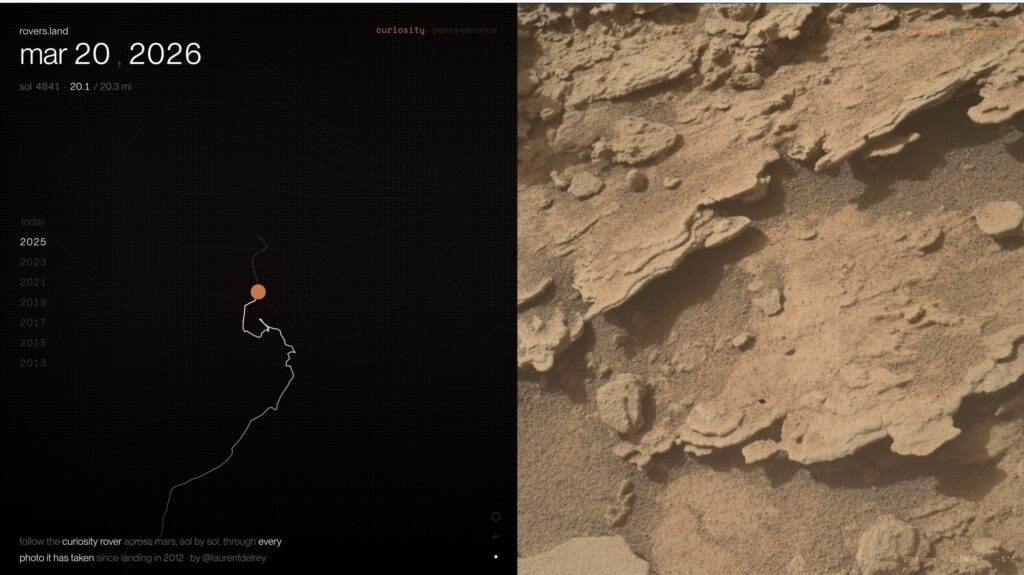
Follow the Mars Curiosity rover
Part map, timeline, and image archive, https://www.rovers.land puts a fun interface together to view the Mars Curiosity rover.