Category: Books

All things books, fiction, nonfiction, sci-fi, thriller, horror, comics, literary

  • Updating books with modern pop culture references

    Updating a piece of media to adapt the to modern culture can be done well. Shakespeare’s Taming of the Shrew transformed into 10 Things I Hate About You quite well. But there’s a growing trend of updating contemporary books with dated references to more modern ones.

    “You guys want to come over and watch this cool TikTok I found?”

    This line, from a recent reprint of Sara Shepard’s young adult thriller “Pretty Little Liars,” drew criticism online this spring after a reader said it “ruined the whole book.”

    In the original edition, from 2006, the same passage referred to the reality show “Fear Factor.” The updated version, from 2022, replaces it — and other early-2000s markers — with references to Instagram, Snapchat and artists like Billie Eilish and Doja Cat.

    In publishing, the practice of updating cultural and technological references in older books is called modernization. It is most common in, but not exclusive to, middle-grade and Y.A. fiction, and is distinct from sensitivity editing, which targets language deemed offensive and became a subject of debate following revisions to Roald Dahl’s novels.
  • Confronting JK Rowling’s bigotry

    Sandy Ernest Allen Confronts J.K. Rowling’s Virulent Transphobia.

    Here was an extremely wealthy and culturally powerful woman who, for some reason, insisted on making her bigoted views about people like me openly and widely known. And so, having long debated what to do about this situation, I dug a fire pit in my backyard and burned my complete set of hardcover Harry Potters.

  • Sarah Jessica Parker shares her experience as a Booker Prize judge

    Sarah Jessica Parker shares her experience as a Booker Prize judge. As someone who reads a lot, this part is validating.

    For me as a reader, the idea of not finishing a book, I just really, really struggle with. But with the Booker, you sort of have to adopt a brutality, because if you’re on Page 110 and you’re waiting for the book to rise ….

    Occasionally when I would be reading something, I would reach out to Roddy [Doyle, the judging panel chairman] and say, “Have you touched on this book yet? Here are my feelings about it, but it’s possible I’m spot-on wrong.” And he would write back on WhatsApp and say, “You’re not, I just put that book down, too.”

  • Teens start banned book club

    After books were banned, what better way for teenagers to rebel than to start a banned book club?

    “It was really difficult for our first year,” Gooblar-Perovic added. “We couldn’t be like an official club with our school, because it would be, legally, iffy.”

    The group persisted. After the part of the law that affects school libraries was temporarily blocked by a federal judge, the Banned Book Club gained official recognition from the school. Now, as enforcement of the book restrictions remains frozen under a second temporary injunction, the club has 15 to 25 regular members and meets weekly to discuss books like The Perks of Being a Wallflower, The Color Purple, The Handmaid’s Tale and Fahrenheit 451 — some of the same titles that had been previously removed from the Iowa City Community School District’s libraries. According to Iowa City West High’s library catalog, the books have since been reshelved.

  • Moving on from Dr. Seuss?

    A literature professor examines, Dr. Seuss’s complex history, and where his books fall in children’s literature.

    Still, Seuss dominates so much of our imaginations around childhood. It may take another generation or two to reset our perspective so that Seuss isn’t synonymous with children’s literature. I spoke with Kesi Augustine, PhD, a debut children’s author and scholar whose research focuses on children’s literature to ask for her insights. Recently when Augustine was promoting her picture book, Faith Takes the Train (HarperCollins 2025, illustrated by Mokshini), an adult reader approached her before she had even started her event.

    The reader asked if she was a children’s author, and related that Green Eggs and Ham was his all-time favorite book. As he and Augustine engaged in a conversation about Seuss, Augustine observed the powerful nostalgia that can cast a spell on us for decades, preventing us from discovering new authors. Isn’t 65 years of Green Eggs and Ham enough? What new books will become beloved for generations?

  • The value of an unread library

    Kevin Dickinson on the value of an unread library:

    Shelves of unexplored ideas propel us to continue reading, continue learning, and never be comfortable that we know enough. They provide the foundation for a healthy and robust intellectual humility.

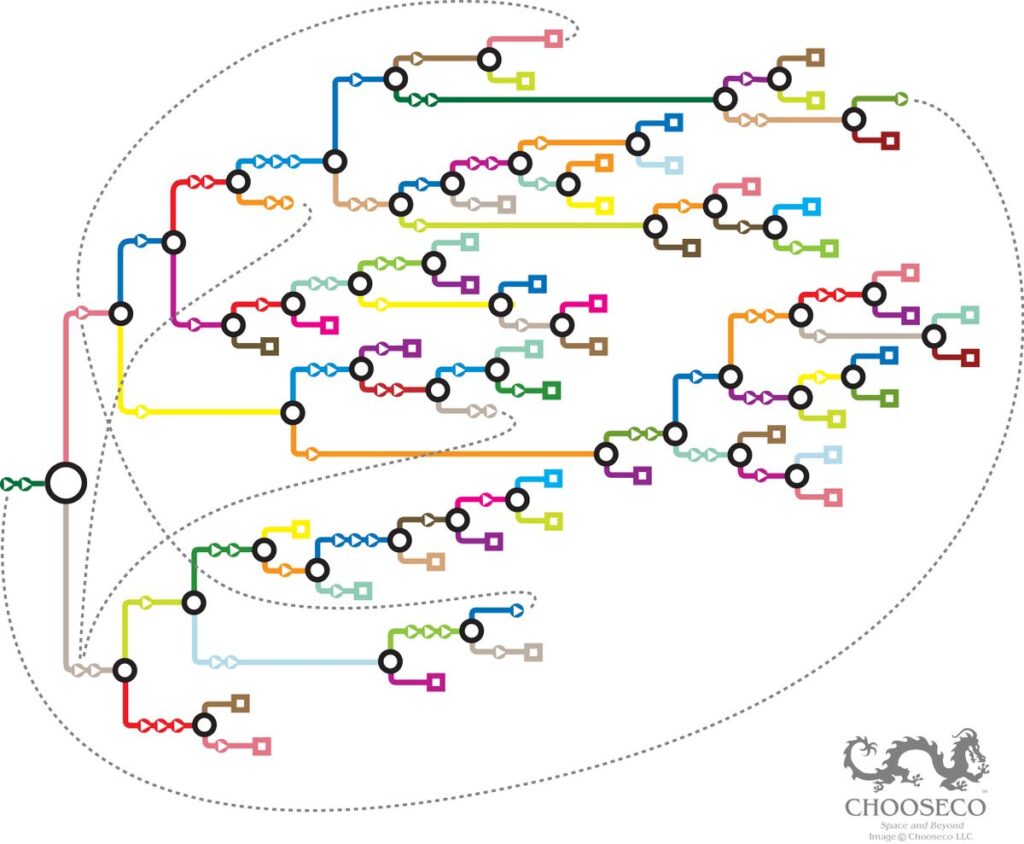
  • Choose Your Own Adventure Books Mapped

    The Choose Your Own Adventure books introduced interactive fiction to millions of school children. While fans have shared diagrams of various branching paths in each book, recently, the publisher has republished some of the original books with diagrams.

    The last installment of the original “Choose Your Own Adventure” series came out in 1998, but since 2004, Chooseco, founded by one of the series’ original authors, R.A. Montgomery, has been republishing classic volumes, as well as new riffs on the form of interactive fiction that seemed ubiquitous in the 1980s and ’90s. The new editions also carry an additional feature—maps of the hidden structure of each book.

  • Jordan Harper – She Rides Shotgun

    She Rides Shotgun will soon be a movie. The book that it’s based on tells of Nate McCluskey and his daughter, Polly, attempting to escape an Aryan Nation branch in Southern California. Jordan Harper writes a taut, propulsive story with hard boiled lyricism, mixing violence and pathos. Definitely recommended as a quick, engaging, easy read.

  • Uncovering new Merlin

    Using a combination of new imaging techniques, a new chapter in Merlin’s story has been uncovered.

    The manuscript had survived the centuries after being recycled and repurposed in the 1500s as the cover for a property record from Huntingfield Manor in Suffolk, owned by the Vanneck family of Heveningham. 

    It meant the remarkable discovery was folded, torn, and even stitched into the binding of the book – making it almost impossible for Cambridge experts to access it, read it, or confirm its origins.

    What followed the discovery has been a ground-breaking collaborative project, showcasing the work of the University Library’s Cultural Heritage Imaging Laboratory (CHIL) and combining historical scholarship with cutting-edge digital techniques, to unlock the manuscript’s long-held secrets – without damaging the unique document.